How I rewrite 2,000 product pages with AI without copywriter rates
- ai
- e-commerce
- content
- pipeline
For a webshop I'm building I have a catalogue of around 2,000 products. Auto detailing products, three languages, technical enough that cheap copywriting shows, and expensive enough that manual copy would take months. No reasonable cost-benefit if I were to write every product page myself.
At the same time I have a strong dislike for the generative product pages you see everywhere now: "experience the premium quality of...". No facts, no specs, no reason to buy. Pure AI filler. Google penalises it, customers smell it.
What I built instead is a pipeline with three LLM roles, each with its own responsibility. Below I explain how it's put together, what the output looks like, and why this isn't the same as "we generate product texts with ChatGPT".
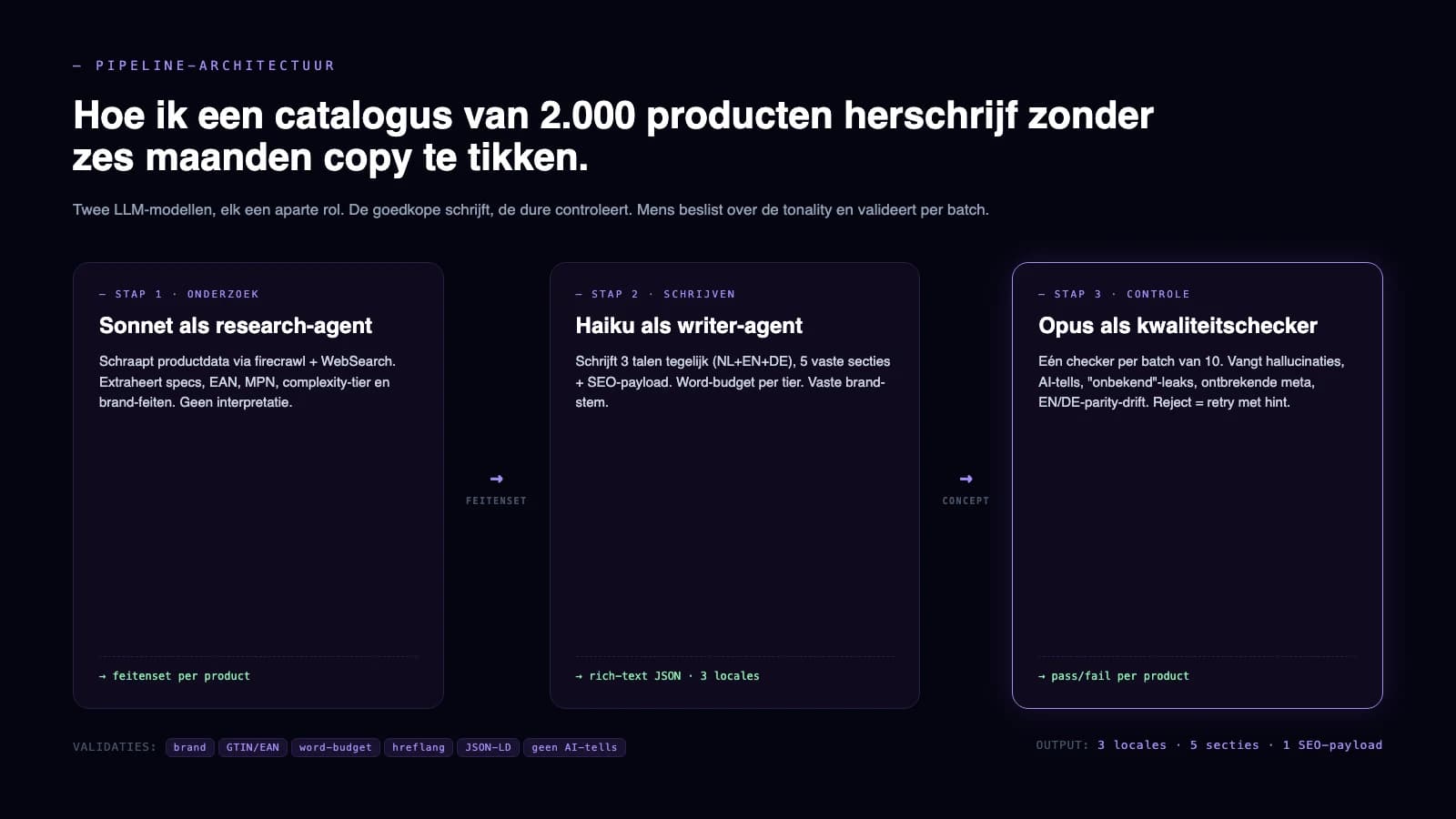
The architecture in three steps
Step 1: Sonnet as researcher. Per product I fetch the product data via firecrawl and targeted web search. The agent extracts specs (volume, pH value, scent, composition, suitable for), identifiers (EAN, MPN, GTIN, brand), category and complexity tier. No interpretation, no writing. Just facts in a structured JSON document.
This part is the most important, even if it looks boring. If the fact set is wrong, the next step writes nonsense. That's why there's a hard sanity check: if the EAN is missing, the pipeline stops and the product is sent to a manual queue. No letting rubbish through.
Step 2: Haiku as writer. A cheap, fast agent that writes 3 languages per product simultaneously: Dutch, English and German. Five fixed sections per locale:
- Short description (60-120 words, describes what the product is)
- What's in the box (literal: number of bottles, size, accessories)
- Why this product (bullet list with 4-6 substantive arguments)
- How to use it (numbered steps)
- Pros and cons (honest, so including the cons)
Plus an SEO payload: meta title (max 60 characters, with brand and product name), meta description (max 155 characters), tags, and a field for JSON-LD data. Word budget per tier. Fixed brand voice configured per project in a prompt template.
Step 3: Opus as quality checker. Per batch of ten products one Opus agent runs as reviewer. It checks:
- No "unknown" leaks in the output (a classic AI tell: "suitable for unknown")
- No hallucinated terms ("in accordance with EU directive for X" when X doesn't exist)
- EN/DE parity with the Dutch version (same core facts, not the same wording)
- Word budget respected, AI tells absent ("delve", "robust", "seamless")
- SEO payload complete and correct (length, format, JSON-LD requirements)
If something fails, the Haiku step retries with a specific hint. If it passes, it goes to the import table with a quality_passed flag.
What the output actually looks like
An example from the pilot: D-CON Mint Splash Shampoo. This is the Dutch PDP that comes out of the pipeline:
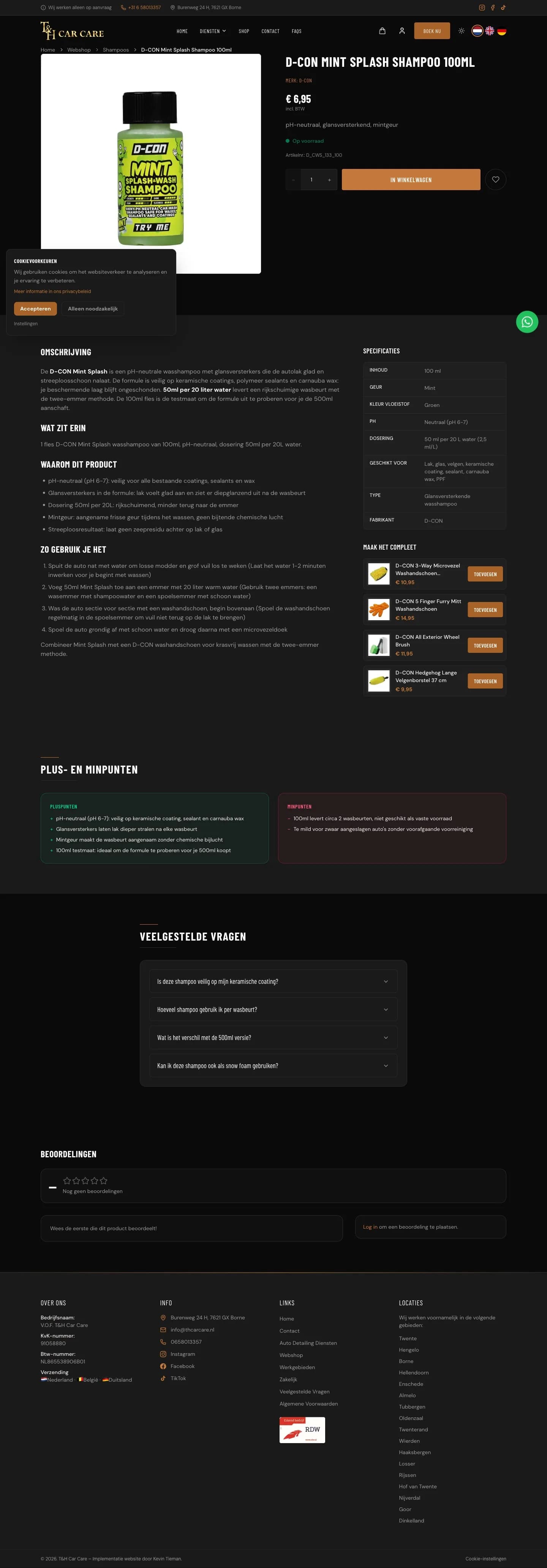
Specs on the left, running text on the right. Pros and cons in an honest two-column box. FAQ at the bottom with answers drawn from the fact set, not from Haiku's imagination. Including the cons (100ml provides approximately 2 washes, not suitable as a standing stock) because honesty converts.
And the same product page in English, from the same pipeline run:
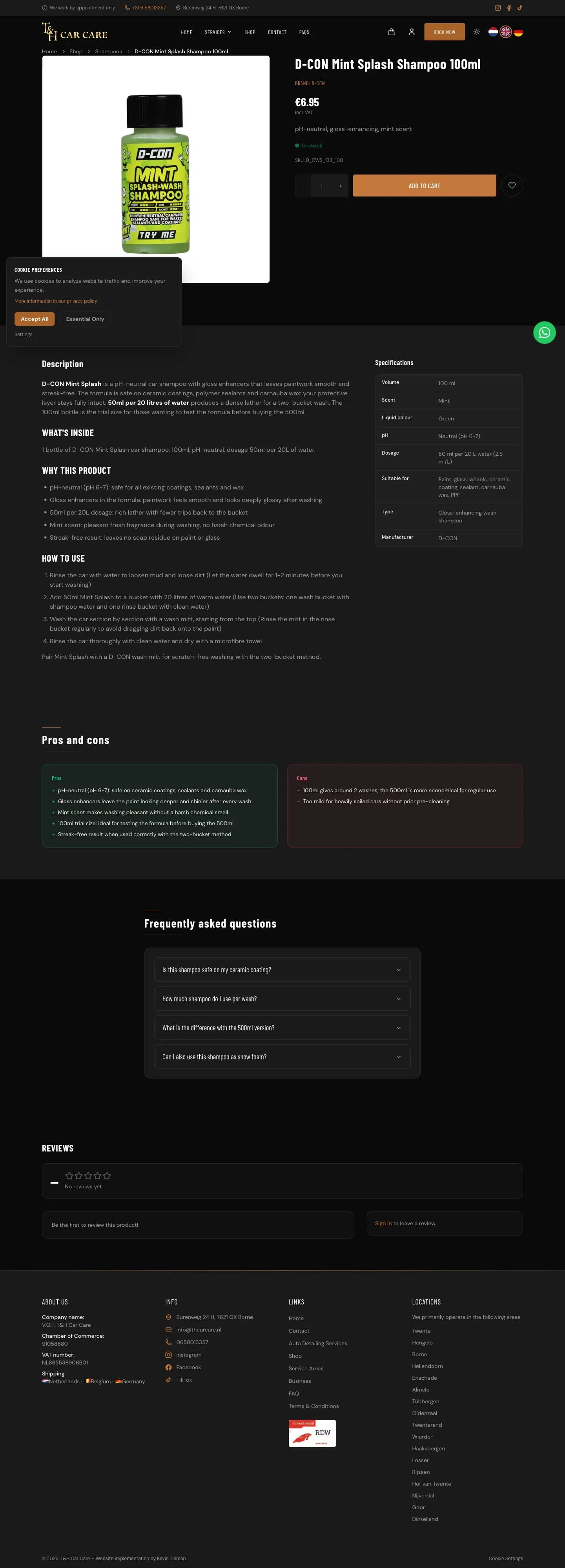
Identical structure, identical facts, different language. That's what hreflang parity means in practice: you're telling Google this is the same product page in a different language, and Google verifies that by laying the structure and identifiers side by side.
What the pipeline doesn't do
No marketing fluff. No "immerse yourself in the premium experience". No comparisons with things you made up ("70% better than the competition"). No fake reviews. No generated product photos that misrepresent the actual packaging.
What I can do, and what we're exploring: upscaling of existing product photos (faithful, not generative), variations of the same photo in different contexts (in a workshop, held in hand), and short product videos through an external partner like Highsfield. But that's a separate step that comes after the text, and only once the catalogue owner has signed off on the IP implications.
When this works and when it doesn't
This works when:
- Your catalogue is large enough that manual copy is impossible (>500 products)
- The product data is standardised (specs are extractable, EANs are there)
- You have a brand name with a recognisable voice you can lock into a prompt
- You're willing to review the output, not publish it blindly
This doesn't work when:
- You sell fashion or furniture where the "feeling" is the main selling argument
- Your catalogue has 50 products and handcraft delivers better output
- You have no brand voice of your own and basically copy the supplier text (in that case you're better off just importing it)
- You want fake reviews or spun content (I don't do that, and I don't want anyone who does as a client)
What it costs and what it delivers
In model tokens this comes to around two to five cents per product across the entire three-step pipeline. For 2,000 products you're looking at roughly forty to a hundred euros in API costs. On top of that comes my time to configure the pipeline instructions per project (a few days of work for the first project, faster per follow-on project because the structure is reusable).
The alternative: a copywriter who can handle 800 products per month at, conservatively, fifteen euros per page. That's thirty thousand euros for one catalogue. And without the multilingual parity this pipeline guarantees.
The pipeline is partly live on a webshop I'm building, thcarcare.nl. You can see the output in production there and judge for yourself whether it's readable enough to open your wallet.
Want to talk directly?
Do you have a catalogue of hundreds or thousands of products that you'll need to rewrite sooner or later, and want to know if this approach fits what you sell? Send me a message with your catalogue size and a few example products. I'll give you an honest assessment within one working day of whether this works for you or not.
Ready to get started?
Get in touch for a no-obligation conversation about the possibilities.